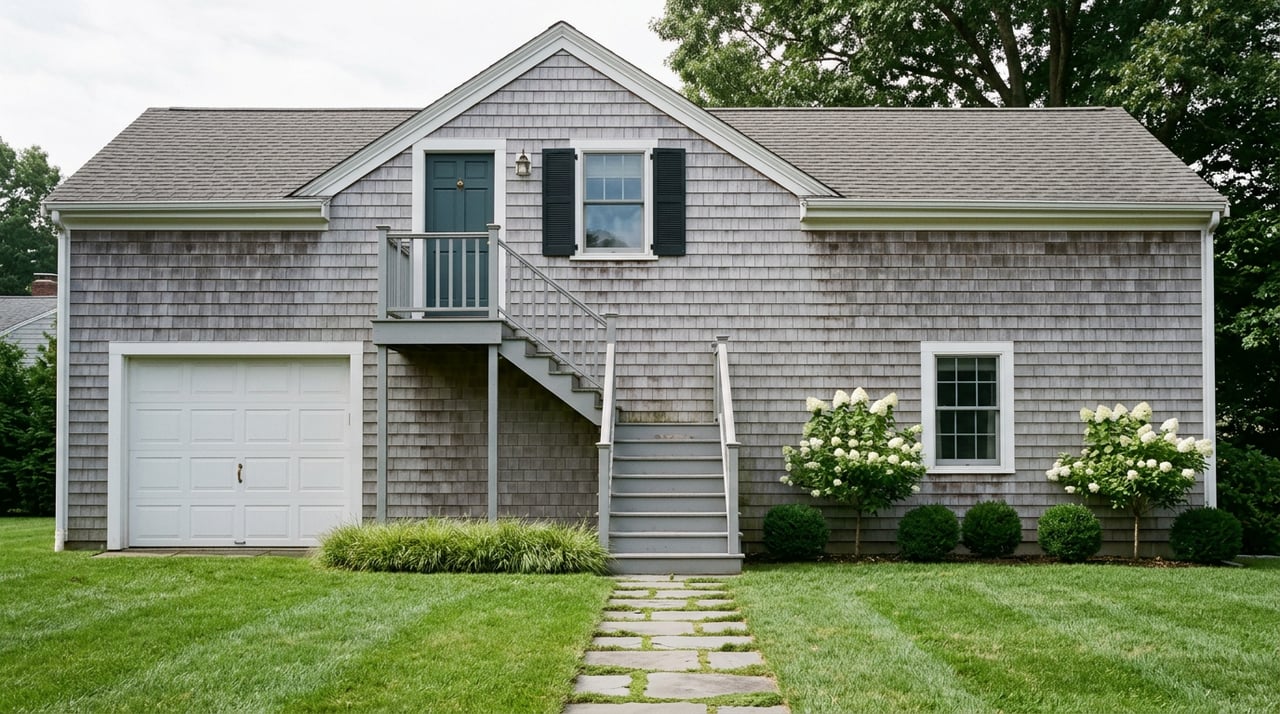
In late August 2025, someone pulled a building permit at 28 Back River Road in Amesbury and listed the project type as ADU, with a filed construction value of $48,000. A few days later, another ADU permit landed at 29 Beacon Street. Neither address made news. Both sit quietly in the city's August 2025 building permit log, two lines among roof jobs, window replacements and a water damage repair.
Those two permits are a useful local data point: Amesbury has permitted accessory-apartment projects, while the Housing Progress page describes the city's in-law apartment ordinance.
Amesbury's Housing Progress page
Go to Amesbury's own Housing Progress page today and you'll find a description of the city's accessory dwelling unit policy that reads like this: the city currently has an in-law apartment ordinance, but it requires that the occupants be direct blood relatives. The page goes on to say Amesbury intends to use its Housing Element process to eventually write a more inclusive ADU ordinance.
The legal framework changed on February 2, 2025, when state ADU protections took effect.
Here's the timeline. Governor Healey signed the Affordable Homes Act on August 6, 2024. Sections 7 and 8 of that law amended the state Zoning Act to allow accessory dwelling units under 900 square feet to be built by right in single-family zoning districts statewide. The implementing regulations, known as 760 CMR 71.00, were published in the Massachusetts Register on January 31, 2025, and the by-right protection took effect two days later, on February 2, 2025.
The state's own FAQ on this is direct: as of that date, any local zoning provision inconsistent with the ADU law became unenforceable. The Metropolitan Area Planning Council, which helped draft the model zoning language towns are using to update their own bylaws, put it plainly too: for any community with an existing ADU ordinance, sections that conflict with the new state law, an owner-occupancy requirement being the example they cite, are unenforceable regardless of whether the town has gotten around to rewriting its own code.
A blood-relative occupancy requirement is exactly the kind of restriction that falls into that bucket. For a Protected Use ADU, the state framework controls even while the Housing Progress page describes the city's in-law apartment ordinance.
How the state framework compares with the city page's description
| Amesbury's Housing Progress page describes | What's actually enforceable statewide since Feb 2, 2025 |
|---|---|
| Occupants must be direct blood relatives | No relation requirement can be imposed on a Protected Use ADU |
| Implied discretionary local approval | By-right: a qualifying ADU needs a building permit only, no special permit or zoning variance |
| No mention of owner-occupancy | Neither the main house nor the ADU can be required to be owner-occupied |
| Silent on size | Up to 900 square feet, or half the primary home's floor area, whichever is smaller |
This matters for a very specific kind of Amesbury buyer: someone looking at a single-family lot with an oversized garage, a barn, or a finished basement, trying to figure out whether that space is a genuine second income stream or just square footage. For a qualifying Protected Use ADU, the answer doesn't depend on whether they're housing a relative.
What the city can still say no to
None of this means Amesbury has no say in the matter. The state framework is generous but not unlimited, and a few things remain squarely local.
Setback and design standards still apply, Septic capacity is a real constraint in parts of Amesbury that aren't on city sewer, since Title 5 compliance is required regardless of what zoning allows. And, as Autonomous explains, a town can restrict or ban Airbnb-style rentals of an ADU even though it can't restrict who lives there long-term. Anyone considering an Amesbury property with rental income in mind, whether that's a long-term tenant or a shorter booking, should confirm with the city's building department which of those local rules actually apply to the specific lot in question, rather than assuming either the most permissive or the most restrictive answer.
The permit numbers versus the real cost
The $48,000 filed at 28 Back River Road is worth pausing on, because it tells you less than it seems to. A filed construction value on a permit reflects what the applicant declared for the purpose of calculating permit fees, not necessarily the full market cost of the finished unit. Statewide, realistic ADU construction costs run considerably higher: garage conversions typically land in the $150,000 to $200,000 range, basement or attic conversions between $175,000 and $250,000, attached additions from $200,000 to $300,000, and detached new builds anywhere from $225,000 to $450,000 or more, working out to roughly $250 to $400 per square foot in the Greater Boston market.
That gap between a modest filed permit value and the actual range of build costs is a reminder that permit data is a starting point for due diligence, not a finished number. A buyer evaluating a lot with ADU potential should treat any filed construction value the same way they'd treat an assessor's estimate: informative, but not the number to build a rental income projection on.
Financing is also shifting. BMN Boston reports that MassHousing opened applications on March 17, 2026 for a dedicated ADU loan product: a second mortgage of up to $250,000 for a detached unit or $150,000 for an attached one, structured as a blended loan with an amortizing portion at 5.25 percent over 20 years paired with additional zero-interest, deferred funding that lowers the effective cost. Eligibility caps out at 135 percent of area median income, which runs roughly $205,000 in eastern Massachusetts. For a buyer weighing whether an Amesbury property's garage or basement is worth converting, that program changes the math on financing a project that used to depend entirely on home equity.
Also worth factoring in: Amesbury's FY2025 residential property tax rate sits at $15.30 per $1,000 of assessed value, about 23 percent above the Massachusetts average of roughly $12.40. Adding a finished, code-compliant living unit to a property will typically raise its assessed value, and that tax rate is the number that translates added square footage into an added annual bill. It's not a reason to avoid building one, but it belongs in the rent-versus-cost conversation from the start.
Why this fits Amesbury's bigger housing picture
ADUs aren't happening in isolation here. Amesbury is designated an Adjacent MBTA Community under state law and is required to zone for at least 789 multi-family units, a requirement the city is partly addressing through the Rocky Hill Multi-Family Overlay District, the area formerly known as the Golden Triangle, approved by City Council in October 2024. The Lower Millyard, meanwhile, continues its shift from industrial mill space toward mixed-use development, already home to Heritage Park, the Riverwalk, the Amesbury Senior Center and a growing base of small manufacturers and makers.
An accessory apartment on an existing single-family lot is a much smaller lever than a multi-family overlay district, but it's a lever that doesn't require rezoning, a developer, or years of permitting. It's available today, on a lot someone may already be touring.
A short FAQ
Can I rent an Amesbury ADU to someone who isn't related to me? Yes. Any local rule requiring the occupant to be a blood relative is unenforceable against a Protected Use ADU built under the state's by-right framework.
Can I use an Amesbury ADU as a short-term rental? That's one of the few areas still governed locally. The state law lets municipalities restrict or prohibit short-term rentals of an ADU, so this is worth confirming directly with Amesbury's building department before assuming either way.
Do I need a special permit to build one? Not if it qualifies as a Protected Use ADU under the state framework: 900 square feet or less, or half the primary home's floor area, whichever is smaller. That path requires a building permit only. A larger or second ADU on the same lot can still trigger a special permit process.
If you're weighing an Amesbury property with an unused garage, a finished basement, or extra yard depth, the question to answer before you write an offer is what that specific lot, with its setbacks, septic system and square footage, can support under the rule that's in effect right now. That's the kind of read that changes what an offer should look like, and it's exactly where a local agent's read on zoning, permitting history and comparable ADU builds earns its keep.
Curious what your own Amesbury lot could support, or what a property with an existing accessory unit is really worth on today's market? The Barnes Team can walk through the specifics with you. Get your instant home valuation to start the conversation.
This article is general information, not legal, tax or financial advice. Consult a qualified professional about your situation.